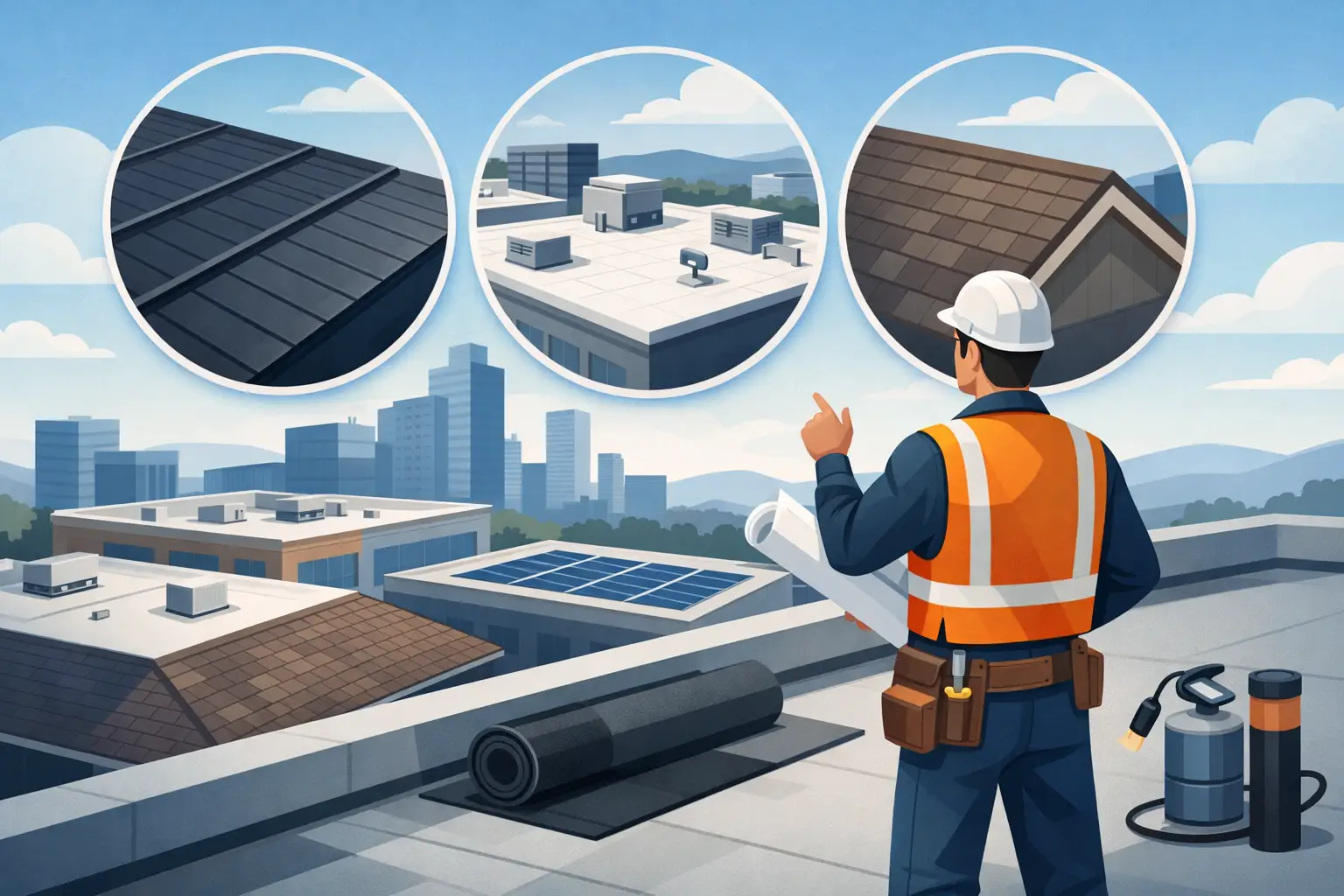
A commercial roof decision usually gets made under pressure – active leaks, a tenant complaint, a failed inspection, or a replacement budget that suddenly moved to the top of the list. That is exactly why knowing how to choose commercial roofing matters before proposals start arriving. The right system is not just the one with the lowest price. It is the one that fits your building, your risk tolerance, your maintenance plan, and the way the roof will actually perform over time.
For property owners and managers, the stakes are high. A roofing mistake can lead to interior damage, energy loss, business interruption, and repeated repair costs that eat away at any upfront savings. A good decision starts with understanding that commercial roofing is never one-size-fits-all.
How to choose commercial roofing for your building
The first question is not which membrane or material is best. The first question is what your building demands from the roof. A warehouse, retail plaza, office property, and multi-unit residential building may all need different solutions even if the square footage looks similar.
Start with building use. If the roof supports frequent service traffic from HVAC technicians, durability and puncture resistance should move higher on your list. If the property has sensitive interior operations, such as electronics, records, or tenant spaces that cannot tolerate water intrusion, reliability and detail work around penetrations become critical. If energy performance matters, insulation value and reflectivity may influence your choice.
Roof design also affects the answer. A low-slope commercial roof requires a very different system than a steep-slope section. Drainage patterns, parapet walls, curb details, skylights, rooftop equipment, and edge conditions all influence what system can be installed properly and maintained without constant trouble.
Climate matters too. In places like Toronto and the surrounding area, a commercial roof has to deal with freeze-thaw cycles, snow load, wind exposure, UV radiation, and heavy rain. Materials that perform well in one region may need a different assembly, thicker insulation, or more careful detailing in another.
Compare roofing systems by performance, not just price
Property owners often begin by comparing quotes line by line. That is reasonable, but it can also be misleading. Two proposals may look similar in price while offering very different long-term value.
Single-ply membranes such as TPO and EPDM are common on low-slope commercial buildings. TPO is often selected for its heat-welded seams and reflective surface, which can support energy goals in some applications. EPDM has a long track record and can be a practical option when flexibility and weather resistance are priorities. Modified bitumen and built-up roofing systems are also widely used, especially where layered protection and proven durability are valued.
Metal roofing may be the better fit for certain commercial structures, especially when lifespan, appearance, and low long-term maintenance are priorities. The trade-off is usually a higher initial investment and the need for a contractor with the right fabrication and installation experience.
No system is universally best. TPO can be a strong option, but seam quality and installer skill matter. EPDM is dependable, but detailing and attachment method still make a major difference. Metal lasts a long time, but not every building benefits enough to justify the cost. The right comparison looks at service life, maintenance needs, repairability, energy performance, and installation quality together.
How to choose commercial roofing based on budget and lifespan
Budget matters, but it should be viewed in phases rather than as a single number. There is the installation cost, the maintenance cost over the roof’s life, and the cost of failure if the system is poorly matched to the building.
A lower upfront number can be expensive if the roof requires frequent repairs, has a shorter service life, or creates recurring drainage issues. On the other hand, paying for the most expensive system available does not automatically make it the smartest decision. If the building may be sold, redeveloped, or significantly altered within a shorter time frame, a different roofing strategy may make more financial sense.
This is where lifecycle thinking helps. Ask how long you expect to keep the property. Ask what level of maintenance your team can realistically support. Ask how disruptive future repairs would be for tenants or operations. Those answers often narrow the field quickly.
A responsible contractor should be able to explain not only what a roof costs today, but what you are likely buying in terms of years of service, expected maintenance, and warranty value. If that conversation never happens, the quote is incomplete.
Look closely at drainage, insulation, and rooftop details
Many roof problems are not caused by the field membrane alone. They start at transitions, penetrations, edges, drains, or poorly designed insulation layouts. That is why a serious roof assessment should go beyond naming a material.
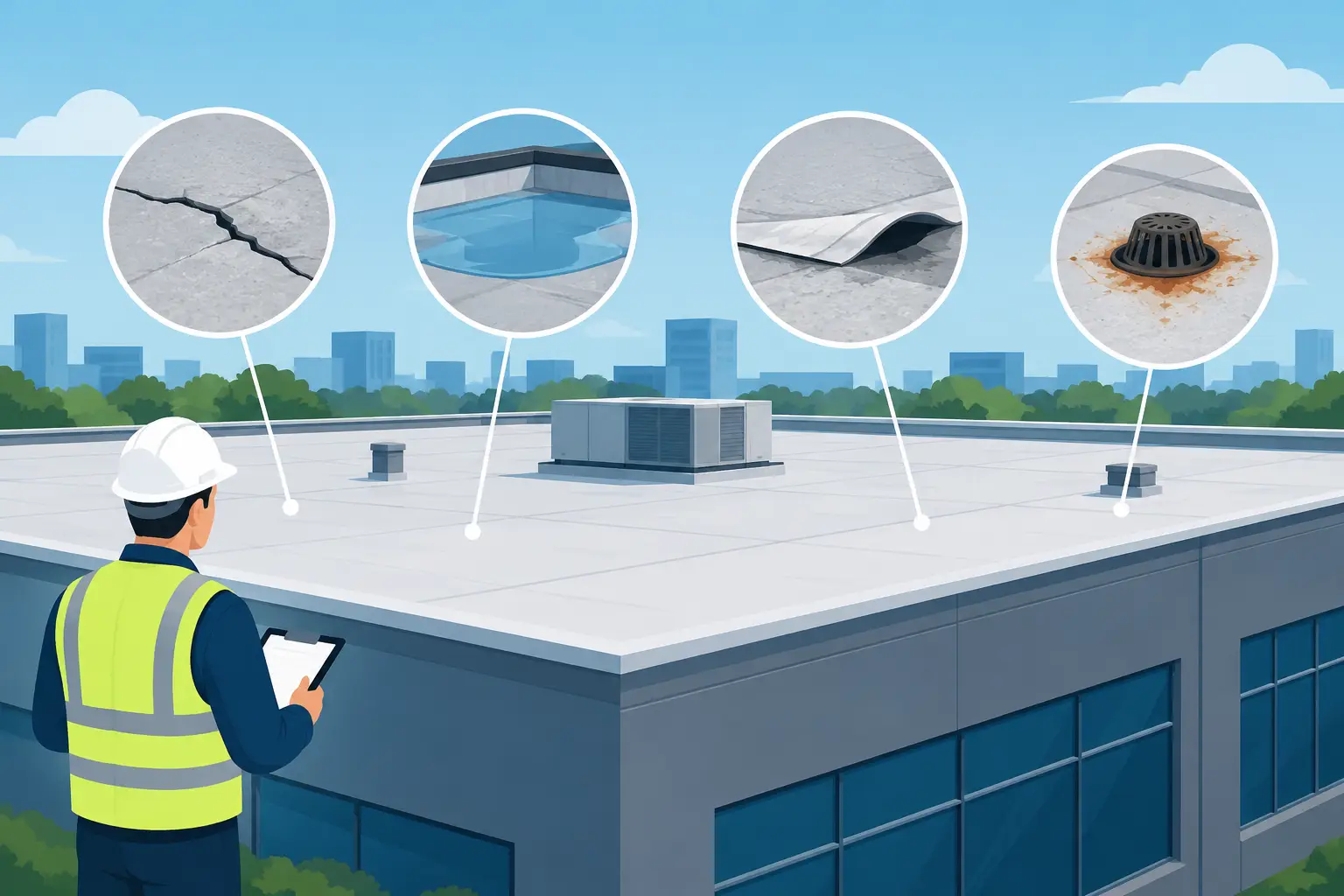
Drainage is one of the biggest factors in commercial roof performance. If water ponds for extended periods, the roof system is under more stress and the building carries more risk. A proper review should assess slope, drain placement, overflow provisions, and areas where water already collects.
Insulation deserves the same attention. Commercial roofing is not only a waterproofing system. It is also part of the building envelope. The right insulation assembly affects energy use, interior comfort, condensation risk, and overall system performance. In some cases, tapered insulation can help correct drainage issues at the same time.
Then there are the details that often separate a roof that performs from one that causes callbacks. Flashings around penetrations, rooftop unit curbs, wall tie-ins, expansion joints, and edge metal all need to be specified and installed with care. A clean-looking proposal that skips over these items should raise concern.
Contractor qualifications matter as much as the material
Even the best roofing product can fail when the installation is rushed, poorly supervised, or handed to crews without the right training. If you are deciding how to choose commercial roofing, you are also deciding how to choose the contractor who will execute the system.
Look for direct accountability. An in-house team with trained installers and owner oversight generally gives you better consistency than a company that relies heavily on loosely managed subcontract labor. Ask who will be on site, who supervises the project, and who is responsible for quality control.
Certification matters, but it should be specific. Manufacturer credentials, safety compliance, and documented training standards tell you more than broad claims about experience. Working at Heights compliance, annual recertification, and product-specific installation knowledge are practical indicators that a contractor takes workmanship seriously.
You should also expect a detailed estimate, not a vague price. The scope should clearly identify tear-off or recover plans, substrate conditions if known, insulation, membrane type, flashing details, accessories, cleanup, and warranty terms. Ambiguity during estimating often becomes conflict during installation.
Understand warranties before you rely on them
Warranties help, but they do not replace good design and proper installation. Many property owners hear the warranty term first and the exclusions later.
A manufacturer warranty may cover material defects, but workmanship coverage depends on the contractor and the exact warranty issued. Some warranties are stronger than others, and many require specific installation methods, approved assemblies, and documented maintenance. Unauthorized alterations, neglected drainage issues, or damage from rooftop trades can affect coverage.
That does not make warranties less valuable. It means they should be read carefully and discussed openly. Ask what is covered, what is excluded, what maintenance is required, and who responds if there is a problem. A trustworthy contractor will explain the difference between manufacturer backing and contractor workmanship responsibility without overselling either one.
Choose a roof system that you can maintain
Every commercial roof needs maintenance. Even a new system can be compromised by clogged drains, storm damage, foot traffic, or neglected flashing details. If the maintenance plan is unrealistic, the roof choice may be unrealistic too.
A smart selection process includes thinking about inspections, service access, seasonal checks, and repair response. Some systems are easier to inspect and patch than others. Some buildings have traffic patterns that call for walkway protection. Some owners need a roof assembly that works well with a proactive maintenance program because they manage multiple sites and need predictable upkeep.
This is where a contractor’s service capability matters after the install, not just during the sale. Commercial roofing is not a one-time transaction. It is an ongoing asset management decision.
The strongest roof choice is usually the one made with clear information, realistic expectations, and disciplined installation standards. If a contractor takes the time to evaluate your building, explain trade-offs, document the scope, and stand behind the workmanship, you are already closer to a roof system that will protect the property the way it should.